Your supplier just told you the N42EH magnets you've been buying for three years now need a 90-day export license — and they're not even sure the license will come through. The product launch is locked. The customer is asking for ship dates. Every Chinese magnet supplier you contact says the same thing: "we'll let you know."
I've watched dozens of engineers walk into this exact wall from mid 2025. There's a way around it most of them never see.
The cleanest workaround to China's NdFeB export controls is to buy a complete motor with the restricted magnets already installed — because finished motor assemblies are classified differently than raw magnets and do not require the same export license.

This isn't a loophole exploit. It's a structural reality of how the regulations were written — and Chinese manufacturers have been quietly redesigning around it for almost a year. The Institute for Energy Research1 reported that "the restrictions only cover magnets, not finished parts." That's accurate, but it leaves out what actually matters: when this approach works, what it costs, and how to vet the supplier offering it. I'll walk you through all of that — with a real customer case at the center.
Why Buying the Motor Works Where Buying the Magnet Doesn't
The intuition trips most buyers up. If a motor contains a restricted magnet, why isn't the motor also restricted?
Buying a motor instead of a magnet works because China's export licensing operates on HS codes — and the HS code for a sintered NdFeB magnet (8505.11) is treated separately from the HS code for a brushless motor (8501.10 / 8501.31), with the current control regime targeting the magnet code only.
There's also a policy logic behind the gap. As CSIS analysis2 and IEA commentary3 have both noted, the policy is designed to control the supply of magnetic material to foreign manufacturers — to prevent foreign motor and EV companies from assembling their own products with Chinese magnets. When the Chinese factory is the one doing the assembly, the magnet stays in China through its high-value-add stage. The finished motor that crosses the border is treated, for now, as a Chinese manufactured good rather than a magnetic material export.
I had one customer last year who spent four months chasing an export license for N42EH magnets. While he waited, we delivered the same magnets — pressed inside a motor — to another customer in 60 days. Same magnet. Same factory. Different paperwork.
This is also why finished EVs, finished wind turbines, and finished consumer electronics with embedded NdFeB magnets continue to flow out of China largely unaffected. The control point is the magnet shipment, not every downstream product.
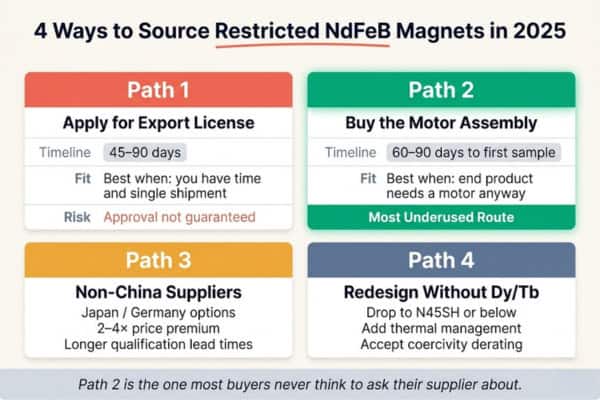
For a buyer who needs Dy/Tb-grade magnets, this opens four practical paths:
| Path | What You Do | When It Fits |
|---|---|---|
| 1. Buy the magnet with a license | Wait 45–90 days, submit end-use statement | Single-shipment buyers with time flexibility |
| 2. Buy the magnet pre-installed in a motor | Source the assembly instead of the part | When end product needs a motor anyway |
| 3. Buy from non-China suppliers | Japan (Proterial4, Shin-Etsu, TDK), Germany (VAC5) | When budget allows 2–4× price + longer lead times |
| 4. Redesign without Dy/Tb | Drop to N45SH or below, add cooling, accept derating | When performance margin allows |
Path 2 is underused, mostly because buyers don't realize their existing Chinese magnet supplier can often arrange it. For Path 1, our dual-use export controls compliance guide6 walks through the license process step by step. For Path 4, our heavy-rare-earth-free magnet line7 is a parallel solution for buyers whose application can tolerate lower coercivity.
Case Study: 60 Days From Inquiry to N50UH Motor Samples
Customer anonymized. Technical specifications and timeline are real.
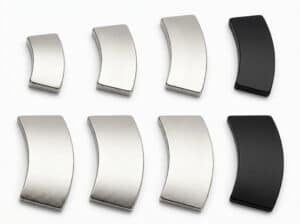
Earlier in 2026, an overseas hardware engineer — I'll call him K. — submitted an inquiry through our website. He wanted six curved sintered NdFeB magnets for a custom brushless motor he was building for a niche high-RPM motorsport application.
By Day 60, he had a vetted motor factory, a complete BOM, sample tooling underway, and N50UH magnets in production for installation — without applying for a single export license.
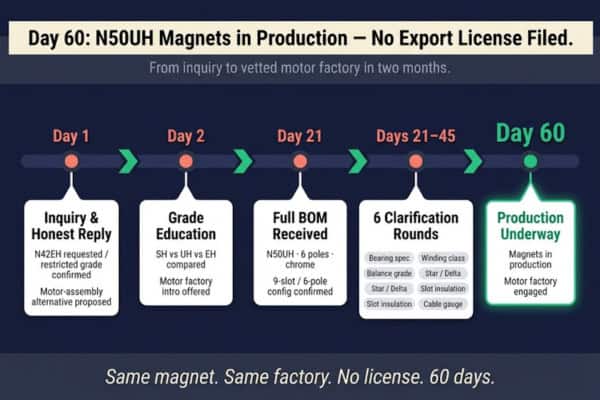
Day 1: The Inquiry and the Honest Reply
K.'s target performance landed in the 27,000 KV range at low voltage — translating to roughly 370,000 RPM no-load speed. The duty cycle involved hard acceleration, hard braking, frequent reversing fields, and significant heat cycling. He had already specified the rest of the motor: 7075-T6 aluminum bell, M2 HSS shaft, Class H wire, 9-slot stator, 0.1mm silicon steel laminations. He asked for the highest grade magnet I could supply.
I had to tell him something he didn't want to hear: the highest grade I could legally ship as raw magnets was 45SH. For his application, 45SH was likely insufficient. He needed something in the UH or EH range — probably N40UH or N42EH. Those grades require Dy/Tb. They are export-controlled.
I offered him the alternative: let us build the complete motor in China with UH-grade magnets installed, and ship the finished assembly. The finished motor would not require the same license regime.
Day 2: The Grade Education Question
K. came back asking two things — the difference between N52SH and UH/EH grades, and help finding a motor factory. I sent him this comparison:
| Grade | Br (kGs) | Hcj (kOe) | Max Operating Temp | Best For |
|---|---|---|---|---|
| N48SH | 13.8–14.2 | ≥ 20 | ~150°C | High remanence, moderate temp, weak reverse fields |
| N40UH | 12.5–13.0 | ≥ 25 | ~180°C | Higher coercivity, better heat & demag resistance |
| N38EH | 12.0–12.5 | ≥ 30 | ~200°C | Extreme temp, strong reverse fields, hard braking |
For sustained high RPM with reversing fields, coercivity (Hcj) matters more than remanence (Br). EH was the right target — but UH would also work if we paired it with better cooling.
Day 21: The Full BOM Lands
After a brief project pause on his end, K. sent the complete motor BOM and engineering drawings. Ten parts, including the final magnet specification: N50UH, six poles, chrome plated.
Worth flagging here: K.'s motor used a 9-slot stator with a 6-pole rotor. That's an unusual configuration — most outrunners use 12N14P or 9N12P — but for his torque/cogging trade-off in this application, it was a deliberate choice. It's the kind of spec a generic motor factory might "correct" silently, without asking. A magnet supplier who understands motor design knows to leave it alone and ask the right confirming question instead.
Days 21–45: Where the Magnet Supplier Earns Its Keep
This is the part most buyers underestimate. K. didn't just need a motor factory — he needed someone who could read his magnet-side requirements and translate them into specifications the motor factory could quote against. Six clarifying items came up he hadn't initially specified:
| # | Item | Final Spec After Clarification |
|---|---|---|
| 1 | Stator core process | Wire EDM for samples, open mold for mass, epoxy slot insulation |
| 2 | Bearing | Si₃N₄ ceramic balls, no flange, no shield, no lubrication, ABEC 7/9 — and then drilling further with the bearing agent since the base model number alone had 100+ variants |
| 3 | Winding wire thermal class | 180°C |
| 4 | Motor cable | 18 AWG silicone, white |
| 5 | Dynamic balance | Target 0, acceptable 0.1–0.2, measured with magnets and shaft together |
| 6 | Winding connection | Star (Y), 3× 26 AWG parallel, 5 turns total — not a single 22 AWG even though copper area is similar, because high-frequency response is different |
Each of those would have taken weeks if K. had been working with a motor factory directly, because the factory's sales engineer wouldn't have known to ask. We knew because we live in this technical territory every day, across our DC motor magnet projects8 and our own motor product lines.
Day 60: Where the Project Stood
Production Test plan complete. Motor factory vetted and engaged. Sample tooling underway. Magnets — N50UH, six poles, chrome-plated — already in production for installation into first sample motors. No export license applied for. No cold-call vendor search. No technical translation gaps.
K. sent us drawings. We sent him a path.
The Two-Tier Reality of China's 2025 Export Controls
Now that you've seen the workaround in action, let me explain precisely what's restricted and what isn't — so you can judge whether your case fits.
China's 2025 export controls under MOFCOM Announcement No. 18 restrict raw rare earth materials and sintered NdFeB magnets containing dysprosium or terbium — but they do not currently restrict finished motors and assemblies that contain those same magnets.
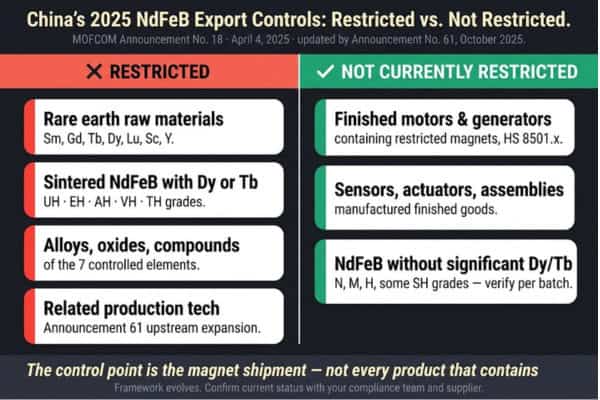
Under the Ministry of Commerce of China (MOFCOM)9 Announcement No. 18 (April 4, 2025), the following are subject to mandatory export licensing:
| Item | Status Under 2025 Controls |
|---|---|
| Rare earth raw materials (Sm, Gd, Tb, Dy, Lu, Sc, Y) | Restricted — license required |
| Sintered NdFeB magnets with Dy or Tb (UH, EH, AH, VH, TH grades) | Restricted — license required |
| Alloys, oxides, compounds of the 7 controlled elements | Restricted — license required |
| Finished motors, generators, sensors, actuators containing restricted magnets | Not currently restricted under the same regime |
| NdFeB grades without significant Dy/Tb content (typically N, M, H, and some SH formulations — confirm per batch with your supplier) | Not restricted |
Announcement No. 61 (October 2025)10 extended controls upstream and downstream — covering rare-earth-related production technologies, and asserting jurisdiction over foreign-made products that contain Chinese-origin rare earth content above 0.1% by value. The November 2025 partial enforcement pause did not dismantle the framework — it changed processing speed for certain categories, not the underlying rules.
If you want the full policy timeline, see our comprehensive guide to importing sintered NdFeB magnets under the 2025 controls11 and our 2025 magnet ban explained for global buyers12. This article assumes you already know the basics.
When This Route Fits — and When It Doesn't
I'd rather lose a deal upfront than have you spend three months on the wrong path.
The motor workaround fits when you need a motor anyway, when annual volumes sit between roughly 100 and 10,000 units, when your end-use is civilian and non-sensitive, and when you can accept a 60–90 day timeline for first samples.
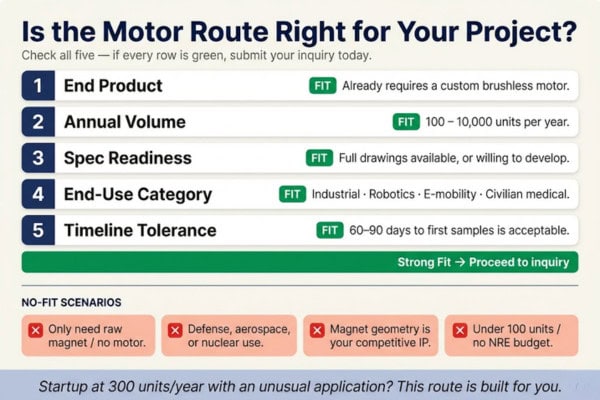
Strong-fit profile, in one table:
| Criterion | Strong Fit |
|---|---|
| End product | Already requires a custom brushless motor |
| Annual volume | 100–10,000 units |
| Specifications | Full drawings + electrical spec available, or willing to develop with us |
| End-use | Industrial automation, robotics, sports/hobby, e-mobility, civilian medical |
| Timeline | 60–90 days from spec lock to first samples is acceptable |
The harder conversation is when it doesn't fit. I once turned away a buyer doing defense-adjacent work who specifically asked for this route. Saying no protected both of us — the motor route doesn't shield restricted end uses, and pretending otherwise just delays the problem until customs flags it on his end.
Here are the four situations where I'll tell you to do something else:
If you only need the raw magnet, not the motor — the motor route doesn't help. Apply for the license, or look at our Gd-free / HRE-free magnet line13 if your application can tolerate lower coercivity.
If your end-use is defense, aerospace, or nuclear — don't use motor classification as a regulatory shortcut. The motor itself will face scrutiny.
If your magnet geometry is your competitive IP — buying raw magnets and assembling in-house exposes less of your design than a custom motor build.
If you're already deeply integrated with non-Chinese motor supply, or annual volume is below 100 units with no R&D budget — the switching cost or amortized tooling cost may exceed the savings.
If you're somewhere in the middle — say, a startup with 300 units/year, an unusual application, and a willingness to learn — that's exactly where this route works best. It's where we've spent most of our last 12 months.
What to Prepare Before You Contact a Supplier
The single biggest cause of slow projects is incomplete specs at the front end. I've seen identical projects diverge by six weeks just because one buyer arrived with a 3D model and the other arrived with a sketch.
Before approaching a supplier about motor-as-magnet delivery, prepare three categories of specifications: magnet side (grade, geometry, coating, tolerance), motor side (3D model, electrical, mechanical, winding), and commercial parameters (volume, end-use, timeline).
On the magnet side, send your required grade — or, better, the underlying performance specification (max operating temperature, expected demag field, target Br and Hcj). Include the magnet geometry: inner radius, outer radius, arc angle, axial length, magnetization direction. Surface treatment preference (NiCuNi, chrome, epoxy, Zn). Tolerance class.
On the motor side, the most useful single artifact is a 3D model in STEP or IGES format, ideally with 2D drawings for each part. Beyond that: electrical spec (rated voltage, target KV or no-load RPM, peak current, continuous power), operating environment (ambient temperature range, vibration, IP rating if relevant), mechanical interface (shaft, mounting pattern, envelope), winding requirements (gauge, turns, Star vs Delta, thermal class, parallel strands), dynamic balance grade, sample quantity and target timeline.
On the commercial side, tell us your volume expectations (first samples, pilot, annual run rate), your country of import and any known regulatory restrictions on your end, and a clear end-use description for our internal compliance review.
If you have most of this, you're in good shape. If you have half, we can help fill in the rest through our inquiry process14. If you have a sketch on a napkin and an idea, that's also fine — we just need more time on the front end.
The Risks Worth Knowing Before You Commit
I'd rather tell you the downsides up front than have you discover them at month four.
The main risks are an evolving regulatory framework, real 45–90 day lead times, NRE tooling costs, magnet design exposure to the motor factory, more complex QC scope, continued end-use scrutiny, and underlying material cost inflation.
Three of my customers in 2025 had to revise their compliance approach mid-project when Announcement 61 dropped in October. The framework moves. So here are the seven things I make sure every prospect understands before we start:
| # | Risk | What It Means for You |
|---|---|---|
| 1 | Regulatory framework evolves | Announcement 61 already reached into "parts, components, and assemblies."15 A future amendment could narrow the workaround. Plan with a 12-month horizon. |
| 2 | Real lead times | 45–90 days first samples + 30–60 days pilot. Faster than licenses, but not next-week. |
| 3 | Tooling / NRE costs | Open-mold stator lamination tooling amortizes across volume. Below 500 units/year, per-unit can spike. Hybrid wire EDM helps. |
| 4 | Magnet design visibility | The motor factory sees geometry, grade, magnetization. If magnet shape is your IP, this exposes more than raw-magnet purchase. |
| 5 | QC scope expansion | You're now inspecting a motor, not a magnet. Dynamic balance, winding resistance, no-load current, dielectric withstand — all need acceptance criteria. |
| 6 | End-use still matters | Defense, aerospace, nuclear applications face scrutiny on the motor itself. Not a shortcut for restricted uses. |
| 7 | Material costs rising independently | Underlying NdPr prices are climbing. See our rare earth magnet material price trend for 202616. |
How to Vet a Supplier Offering This Service
Not every magnet supplier can credibly offer this service. A trader can't — only a manufacturer with real motor industry relationships can. The first question I personally ask back when a buyer comes to me is "What are you doing with this motor?" If a supplier doesn't ask that, they're not vetting you — they're just taking your money.
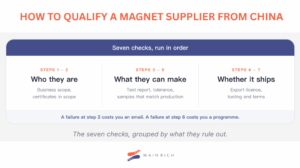
Vet a supplier by confirming they own the magnet IP, have existing motor factory relationships with case history, can read motor drawings, will commit to magnetic-side performance specs, and understand the export-control framework deeply enough to advise on edge cases.
Five questions I'd recommend asking — and what a good answer looks like:
1. Do you own the magnet manufacturing, or are you a trader? A real manufacturer with their own facility, not a broker adding a markup layer. Compare credible players in our top 10 China neodymium magnet manufacturers guide17.
2. Do you have existing motor factory relationships, or will you cold-call? They should name specific factories and specific past projects. At MainRich, we also ship motors under our own SKUs — see MR-280718, MR-281019, MR-311520 — which is a different proposition than introducing you to a stranger.
3. Can you read motor drawings and translate magnet requirements into motor language? Ask them what clarifying questions they'd ask about your spec. Their questions reveal the depth of their knowledge. A good supplier will ask about your demag field, your duty cycle, your peak current — not just your dimensions.
4. Will you commit to magnetic-side performance specs (Br, Hcj, demag curve under operating conditions) in writing? A supplier confident in their work will. A supplier who won't is hedging.
5. Do you understand Announcement 61 and the 0.1% rule? If they shrug, find someone else. The buyers who get burned are the ones whose supplier didn't know what they didn't know.
Conclusion
The magnet is restricted. The assembly isn't. For a meaningful share of buyers in 2026, that single distinction is the difference between a stuck project and a shipping product.
If you want to find out whether your specific case fits, send us your magnet specifications and target application through our inquiry form21. Within 48 hours we'll tell you honestly whether the motor route is right — or whether one of the other three paths makes more sense. We won't always be the right answer. But we'll tell you which answer is.
-
Read the Institute for Energy Research's analysis confirming that China's 2025 export restrictions cover only raw magnets, not finished assemblies that contain them. ↩
-
Explore CSIS's strategic analysis of how China's rare earths export restrictions reshape global supply chains and what they mean for downstream buyers. ↩
-
Learn how the IEA frames critical mineral export controls and the supply concentration risks they create for industries dependent on Chinese magnets. ↩
-
Visit Proterial's official site (formerly Hitachi Metals) to evaluate Japan's leading non-China NdFeB magnet supplier as a Path 3 alternative. ↩
-
Visit VAC's official site to evaluate Vacuumschmelze, a leading German manufacturer of high-performance magnetic materials, as another non-China sourcing option. ↩
-
Learn step by step how to navigate China's dual-use export controls if you decide to apply for a magnet export license rather than using the motor route. ↩
-
Discover MainRich's heavy-rare-earth-free and Gd-free NdFeB magnet line — a parallel solution if your application can tolerate lower coercivity without UH/EH grades. ↩
-
Explore MainRich's DC motor magnet capabilities and past integration projects to see what in-house motor-magnet engineering looks like in practice. ↩
-
Visit the Ministry of Commerce of China's official homepage — the authoritative source for export control announcements including No. 18 and No. 61. ↩
-
Read White & Case's legal analysis of China's Announcement No. 61, including the extraterritorial jurisdiction and 0.1% Chinese-content rule that affect foreign manufacturers. ↩
-
Read MainRich's comprehensive guide to importing sintered NdFeB magnets under China's 2025 export controls, useful as foundational reading before this article. ↩
-
Understand the 2025 China magnet ban in plain language for global buyers, including the April rollout, October expansion, and November partial enforcement pause. ↩
-
Discover MainRich's heavy-rare-earth-free magnet solutions, a viable alternative when the motor route doesn't fit your application. ↩
-
Submit your magnet and motor specifications through MainRich's inquiry form to get a fit assessment within 48 hours. ↩
-
Read China Briefing's analysis of how the 2025 export controls extended to parts, components, and assemblies — important context for assessing the regulatory-evolution risk. ↩
-
Understand the 2026 rare earth magnet material price trend, including NdPr cost spikes that affect motor sourcing economics independently of export policy. ↩
-
Compare credible Chinese neodymium magnet manufacturers using MainRich's industry benchmark guide before committing to a supplier. ↩
-
View the MainRich MR-2807 brushless motor product page — evidence of in-house motor assembly capability across smaller frame sizes. ↩
-
View the MainRich MR-2810 brushless motor product page — another example of in-house motor assembly with embedded NdFeB magnets. ↩
-
View the MainRich MR-3115 brushless motor product page — in-house motor assembly across multiple frame sizes for different applications. ↩
-
Contact MainRich directly to discuss your motor-magnet integration project, sourcing constraints, and timeline. ↩