

Injection Molded NdFeB Magnets
Bonded NdFeB compounded with PA12 or PPS and molded to net shape: no grinding, usually no coating, and multipole patterns written on the magnetizing fixture after molding. Eleven grades from 4.0 to 14.2 MGOe, with the grade data and the three decisions that matter before you pick one.
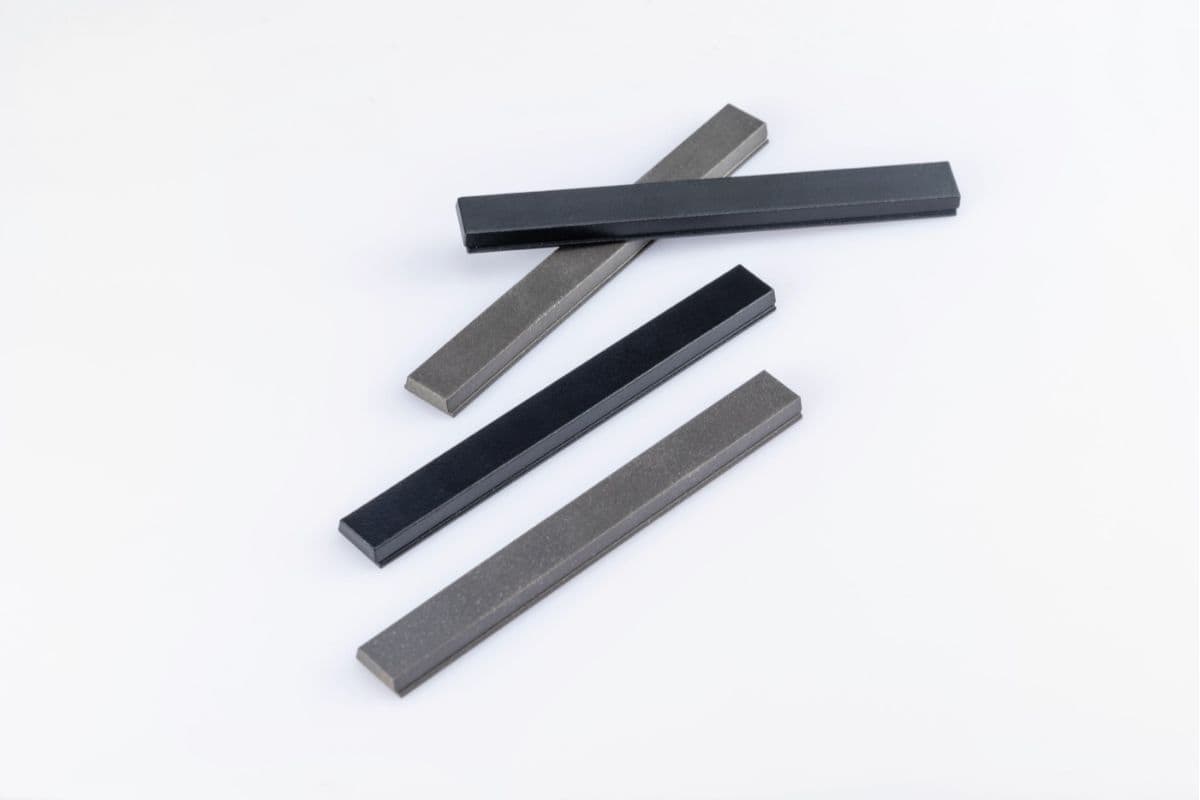
Injection molded NdFeB magnets are bonded neodymium magnets made by molding a compound of NdFeB powder and a PA12 or PPS binder to final shape. Each part leaves the tool at net size, often with a shaft or sleeve molded in, and is magnetized afterwards, so complex shapes and multipole patterns need no extra machining.
"Bonded NdFeB" covers two different products, and quoting the wrong one wastes everyone's week. Compression-bonded magnets press MQP powder with epoxy: higher loading, simple ring and disc shapes, and a coating step. Injection molded NdFeB compounds the powder with a PA12 or PPS binder and molds it to final geometry, which buys you shape complexity, magnet-to-insert assembly in one shot, and a pole pattern that is not limited by how the powder was pressed. Mainrich supplies the injection molded kind, produced in an IATF 16949 certified plant (certificate available on request), alongside the sintered NdFeB we have supplied since 1992 and produced in our own plants since 1994.

Composition note for sourcing teams: these grades are specified on melt-spun NdFeB powders without dysprosium or terbium additions, and material composition is documented per batch, so your compliance team can classify parts on the actual substance list rather than on assumptions. Background reading: China's rare earth export controls.
Before you compare grades, decide which product you are buying. If your design needs maximum flux in a simple ring that gets pressed, coated, and glued into place, that is compression bonding, and we'll tell you so at drawing review. If your part is a thin-wall ring, a multipole rotor, or a magnet that has to live on a shaft or sleeve, injection molding is usually the cheaper way to make it. The three decisions below sort this out in order.
Injection Molded or Compression Bonded?
Both start from melt-spun NdFeB powder. The forming route decides what the part can be, and which supplier you should be talking to.
| Injection Molded (this page) | Compression Bonded | |
|---|---|---|
| Binder | Thermoplastic: PA12 or PPS | Thermoset epoxy |
| Typical BHmax | 4.0–14.2 MGOe | ~8–12 MGOe |
| Shape freedom | Any moldable geometry: thin walls, hubs, gear features, overmolded inserts | Simple rings, discs, cylinders |
| Coating | Usually none: powder is encapsulated in the polymer. Sprayed epoxy where an application asks for it | Required: epoxy spray or e-coat |
| Orientation | Isotropic by default; anisotropic grades oriented by a field inside the mold | Isotropic |
| Multipole magnetizing | After molding, on a dedicated fixture: any pole pattern on isotropic grades | After pressing, geometry-limited |
In practice, compression bonding wins when you need the most flux per cubic millimeter in a shape a press can make. Injection molding wins the moment geometry, pole pattern, or assembly integration enters the requirement. That's why sensor rings, encoder targets, and rotor magnets are overwhelmingly injection molded.
Isotropic or Anisotropic?
Ask one question first: how complex is your pole pattern? The answer picks the grade family, and on anisotropic grades it also locks in what the tooling can and cannot change later. It is a lopsided choice in practice: isotropic MND grades cover roughly 95% of the injection molded work we quote.
Isotropic: MND Grades
No preferred magnetic direction, so the magnetizing fixture can write any pattern into the part: a 32-pole radial ring, an axial multipole face, an index track. This pole-pattern freedom is why nearly every multipole sensor ring uses an isotropic grade, and why roughly 95% of the parts we quote land here. Energy product runs 4.0–8.0 MGOe.
MND-1240 → MND-1280 · pattern-freeAnisotropic: MN / MSN Grades
The powder can be oriented by a magnetic field inside the mold, nearly doubling the energy product: up to 14.2 MGOe. The part is still magnetized after molding either way, but once you orient in the tool, the easy axis, and with it the pole layout, is fixed the day that tool is cut. It is the specialist route: about 5% of what we quote.
MN-12140 · 14.2 MGOe · oriented in the toolFour pole layouts the magnetizing fixture can write into an isotropic ring after molding. Redrawn from the production line's magnetization capability chart.
Rule of thumb: complex or still-undecided pole pattern → isotropic MND. Simple, fixed pattern that needs maximum flux in a small envelope → anisotropic MN. If you are between the two, send the pole layout with your drawing: the pattern usually makes the decision for you.
PA12 vs PPS: Which Binder?
Binder choice causes more field failures than powder choice. Two questions settle it: how hot, and what medium?
PA12: the tough default
Continuous service to 120°C, low moisture uptake, and the better toughness of the two. It's the safer choice for press-fitted and snap-fitted assemblies where the ring takes mechanical stress.
−40 to +120°C · press-fit friendlyPPS: heat and chemistry
Continuous service to 150°C and strong resistance to refrigerants, oils, and most chemicals. This is the binder for expansion-valve rotors, underhood sensors, and anything that lives in a hot or aggressive medium.
−40 to +150°C · chemical dutyShorthand: above 120°C ambient, or any contact with refrigerant or oil, specify PPS. Mechanically loaded press-fit at moderate temperature, prefer PA12. Tell us the medium and the temperature duty cycle and we'll recommend the grade with its demagnetization curve attached.
Injection Molded NdFeB Grade Table
Eleven production grades in two families. Values are typical material data; acceptance limits for your part are agreed at drawing review.
Isotropic grades: MND series (any pole pattern at magnetizing)
| Grade | Binder | Br (Gs) | bHc (kA/m) | iHc (kA/m) | BHmax (MGOe) | Working Temp | Flexural (MPa) |
|---|---|---|---|---|---|---|---|
| MND-1240 | PA12 | 4,500 | 311 | 690 | 4.40 | −40 to +120°C | 116 |
| MND-1250 | PA12 | 5,020 | 335 | 724 | 5.40 | −40 to +120°C | 110 |
| MND-1260 | PA12 | 5,500 | 365 | 728 | 6.28 | −40 to +120°C | 90 |
| MND-1280 | PA12 | 6,250 | 398 | 724 | 8.00 | −40 to +120°C | 61 |
| MND-2240 | PPS | 4,350 | 300 | 680 | 4.02 | −40 to +150°C | 123 |
| MND-2250 | PPS | 4,900 | 322 | 690 | 5.00 | −40 to +150°C | 119 |
| MND-2260 | PPS | 5,300 | 344 | 693 | 5.81 | −40 to +150°C | 107 |
Anisotropic grades: MN / MSN series (oriented in the mold, magnetized after)
| Grade | Powder | Br (kGs) | Hcj (kA/m) | BHmax (MGOe) | α Br (%/K) | β Hcj (%/K) | Flexural (MPa) |
|---|---|---|---|---|---|---|---|
| MN-12120 | NdFeB | 7.86 | 860 | 12.7 | −0.12 | −0.53 | 86 |
| MN-12140 | NdFeB | 8.21 | 1,003 | 14.2 | −0.13 | −0.59 | 84 |
| MSN-12100 | NdFeB + SmFeN | 6.89 | 701 | 10.3 | −0.10 | −0.57 | 99 |
| MSN-12120 | NdFeB + SmFeN | 7.81 | 812 | 12.47 | −0.10 | −0.57 | 91 |
Working temperature on anisotropic grades is confirmed per grade at quotation: the binder is PA12 in all four, but the safe continuous limit depends on the working point of your circuit, which we verify against the demagnetization curve for your geometry.
The Stronger the Grade, the More Brittle the Part
Higher energy product means higher powder loading, and less polymer holding the part together. The numbers from our PA12 isotropic family make the trade visible.
This is not a footnote: it is the failure mode. A ring molded from the strongest grade and rigidly coupled to a copper sleeve concentrates shrinkage stress in the most brittle material in the joint, and it cracks in assembly or in thermal cycling. If your magnet lives on an insert, resist the reflex to specify maximum flux: pick the mildest grade that meets the field requirement at your air gap, and let the joint keep its toughness.
Where These Grades End Up
Three part families cover most of the injection molded NdFeB we quote, split by what leaves the tool: a simple magnetized ring, a finished part with its features already in it, or a magnet already joined to your metal insert.
 Most Quoted
Multipole Sensor & Encoder Rings
EPS steering angle sensing, transmission position, and encoder targets. One isotropic ring can carry a 32-pole pattern, and NdFeB holds the field where ferrite runs out at the gap.
 Net Shape
Complex Single-Piece Rotors
Rotor sleeves for an automotive power seat adjuster. Bore, drive features, and thin outer wall all leave the tool finished. On a sintered magnet, each one is a separate grinding step.
 Assemblies
Magnet-on-Insert Assemblies
The magnet is molded straight onto a shaft or carrier you specify. Flow-meter wheels and valve rotors ship as finished assemblies, not loose magnets to glue on your line.
What You Get Beyond the Compound
The grade is only half the part. Production runs in an IATF 16949 certified plant, with magnetics verified before anything ships.
Pole Pattern
On isotropic grades the pattern is written on a dedicated magnetizing fixture after molding, then checked pole by pole with a flux waveform scan.
Usually No Coating
The powder sits inside the PA12 or PPS matrix, so there is no plating line and nothing to chip in a press fit. Where a surface layer is genuinely called for, it is a sprayed epoxy.
16949 Production
Molding runs in an IATF 16949 certified plant in Guangdong. Certificate and audit visits available on request.
Material Traceability
Every lot ties back to its compound batch and material certificate: the paper trail your SQE will ask for.

Automated Insert Feeding
A feeder loads shafts and sleeves into the tool between shots, so insert seating doesn't depend on the operator. Part 50 seats the same way as part 50,000.

Automated Visual Sorting
A vision sorting station screens molded parts for surface and geometry defects before they reach the packing tray.
From Compound to Packed Tray
Eight stations in Guangdong, photographed on the dedicated line that molds these grades.

Incoming Material Control
Compound and inserts come in against material certificates and get stored by class. This is where batch traceability starts.

Batching & Mixing
Compound is weighed and blended in controlled batches. If powder loading drifts, flux drifts with it, so this step gets its own equipment.

Drying
PA-based compounds pick up moisture; controlled drying before molding prevents voids and streaks in the finished part.

Injection Molding
A row of dedicated machines molds the part to net shape. Geometry, insert bonding, and the magnetic body all come out of one cycle.

Magnetizing & Demagnetizing
Dedicated cells write the pole pattern, or demagnetize where handling and downstream assembly need a neutral part.

Inspection
Dimensions are checked against the drawing on rotary fixtures; magnetics are verified by surface field and waveform scans.

Packaging
Formed trays keep magnetized faces from snapping together in transit, because that's how edges get chipped.

Export Packing
Cartons are palletized in the shipping area, with plywood cases for sea freight when the route calls for it.
What the Numbers Are Measured On
Acceptance measurements on your parts trace back to instruments you can see on a plant visit.

Senis 3-Axis Magnetic Field Mapper
Maps the field over the part surface in three axes. Pole uniformity, zero-crossing spacing, and surface field all get measured directly on the part.

Hexagon Explorer Coordinate Measuring Machine
Measures molded geometry on a granite-base CMM. Bores, runout-critical faces, and true position between molded features get checked against the drawing here instead of with hand gauges.

Accretech Surfcom Contour Instrument
Traces contour and surface profile. On seal faces and press-fit hubs, form error matters more than diameter, and this is what catches it.

Thermal Shock Test Chamber
Cycles parts between temperature extremes. When a binder choice looks marginal on paper, the chamber settles it before volume production does.
When to Step Up to Sintered NdFeB
Injection molded NdFeB tops out around 14 MGOe; sintered N35 starts near 35. Three situations where the answer is our other product line, not a higher bonded grade:
- The air gap genuinely needs sintered flux density: no bonded grade will close a field shortfall of 3× at the working gap
- Continuous service beyond 150°C: past the PPS binder ceiling, the polymer gives out before the magnetics do
- Single-magnet performance outranks geometry: a simple block or arc at maximum energy product is sintered territory
In those cases, start with our sintered NdFeB magnets line and the sintered grade table. We have supplied sintered NdFeB since 1992 and produced it in our own plants since 1994, so stepping up doesn't mean changing suppliers. One caution on paperwork: sintered N-grades (N35–N55) and the MND / MN grades on this page are different systems, and the numbers don't cross-reference.
Related Products & Resources
Frequently Asked Questions
The questions design engineers ask before quoting an injection molded NdFeB part.
Is this the same thing as "bonded neodymium magnets"?
Partly, and the difference matters before you quote. "Bonded NdFeB" covers two products. Compression-bonded: MQP powder pressed with epoxy, high loading, simple ring and disc shapes, needs a coating. Injection molded (this page): powder compounded with PA12 or PPS, molded to net shape, multipole-magnetized after molding, usually no coating. Compression gives you more flux per volume in a simple shape; injection gives you geometry, integrated assembly, and pole-pattern freedom. We make the injection kind, and if your design actually needs compression bonding, we will say so at drawing review.
Should I pick an isotropic or anisotropic grade?
Ask how complex your pole pattern is. Isotropic grades (MND, 4.0–8.0 MGOe) have no preferred direction, so the magnetizing fixture can write any pattern: a 32-pole radial ring, an axial multipole face, an index track. That's why nearly every encoder ring uses them. Anisotropic grades (MN, up to 14.2 MGOe) can be oriented by a field inside the mold: nearly double the energy product, but the easy axis, and with it the pole layout, is fixed the day the tool is cut. Both families are magnetized after molding, not during it. Complex or undecided pattern → isotropic, which is roughly 95% of what we quote. Simple fixed pattern needing maximum flux → anisotropic, the remaining 5%.
PA12 or PPS binder: how do I choose?
PA12 runs to 120°C continuous and is the tougher, more forgiving binder in press-fit assemblies. PPS runs to 150°C and resists refrigerants, oils, and most chemicals, at some cost in toughness. Two quick rules: over 120°C ambient or aggressive media → PPS; press-fitted or snap-fitted at moderate temperature → PA12. Binder choice causes more field failures than powder choice. Tell us the medium and the temperature duty cycle and we'll recommend the grade with the demagnetization curve attached.
Do injection molded NdFeB magnets need plating?
Usually no. The NdFeB powder sits encapsulated in the polymer matrix, so there is no exposed metallic surface to corrode the way a sintered block corrodes. That removes a process step, a cost line, and a failure mode: chipped coatings in press-fit assemblies. The exceptions are prolonged immersion in hot water, where hydrolysis attacks PA-family binders (specify PPS), and severe salt-spray environments. Where a surface layer is warranted, the answer here is a sprayed epoxy rather than the nickel plating a sintered magnet needs, and we review that against your duty cycle at drawing review.
How strong are these compared to sintered N35?
Not close, and the gap depends on which grade you compare. Sintered N35 is roughly 35 MGOe; our strongest injection molded grade is 14.2, and the common isotropic grades run 4.0–8.0, so you are looking at roughly 2.5x against the strongest and closer to 5x against a typical sensor-ring grade. So it's never a drop-in substitution question; it's a geometry question. A multipole ring molded to net shape often beats a machined-and-assembled sintered solution at system level, because the sintered route pays for grinding, assembly, and gluing. If your air gap genuinely needs sintered flux density, use our sintered NdFeB line: same supplier, different physics.
Do these grades contain dysprosium or terbium?
These grades are specified without dysprosium or terbium additions: melt-spun bonded NdFeB powders achieve their coercivity through grain structure rather than heavy-rare-earth doping. We document material composition per batch, which lets your compliance team classify parts on the actual substance list. For the wider sourcing picture, see China's rare earth export controls and the announcements published by MOFCOM.
Material specifications referenced against IEC 60404-8-1 (specifications for individual magnetic materials). Binder property background: PPS polymer guide.