
Choosing between axial flux and radial flux motor magnets starts when a motor has to get short and wide. You trade curved arc segments on a drum for flat sector segments on a disc, and flatness starts to matter more than shape.
What is the difference between axial flux and radial flux motors?
It's the direction the flux crosses the air gap. In a radial flux motor it runs along the radius, from a drum-shaped rotor into the stator.[1] In an axial flux motor it runs parallel to the shaft, between a disc rotor and a flat stator.[2]
Radial flux is still the default in servo, BLDC and EV traction motors. The stator usually sits outside the rotor, or inside it in outer-rotor motors like most drone motors.
Charged EVs draws the double-sided version as one disc between two others, against a radial motor's cylinder inside a larger cylinder.[3]
When does an axial flux motor make sense?
- More torque for a given volume, because the active magnet surface is the rotor face rather than its outside diameter[4]
- A flat shape that stacks onto a wheel, gearbox or robot joint
- An unbalanced axial pull between rotor and stator in single-sided designs, which calls for more complex bearing arrangements and a thicker rotor disc[2]
- Harder magnet retention at high speed, which has to be solved early
Efficiency gains depend on the operating point. One IEEE conference study of two solar race car motors found the axial flux motor more efficient at low torque.[5] Radial flux stays the simpler motor to build and balance when it can be long and slim.
Which magnet shapes does each motor use?
Here's how the magnets change when you move from a drum to a disc.
| Radial flux motor | Axial flux motor | |
|---|---|---|
| Rotor | Drum (cylinder) | Disc |
| Magnet shape | Arc segments, bread-loaf segments, radially oriented rings | Flat sector or trapezoidal segments |
| Magnetized | Radial or parallel, through the thickness | Axial, through the thickness |
| Where they sit | On the rotor surface or buried in the core | On the disc face, facing the stator |
| Critical dimension | Arc radius and thickness | Thickness and flatness |
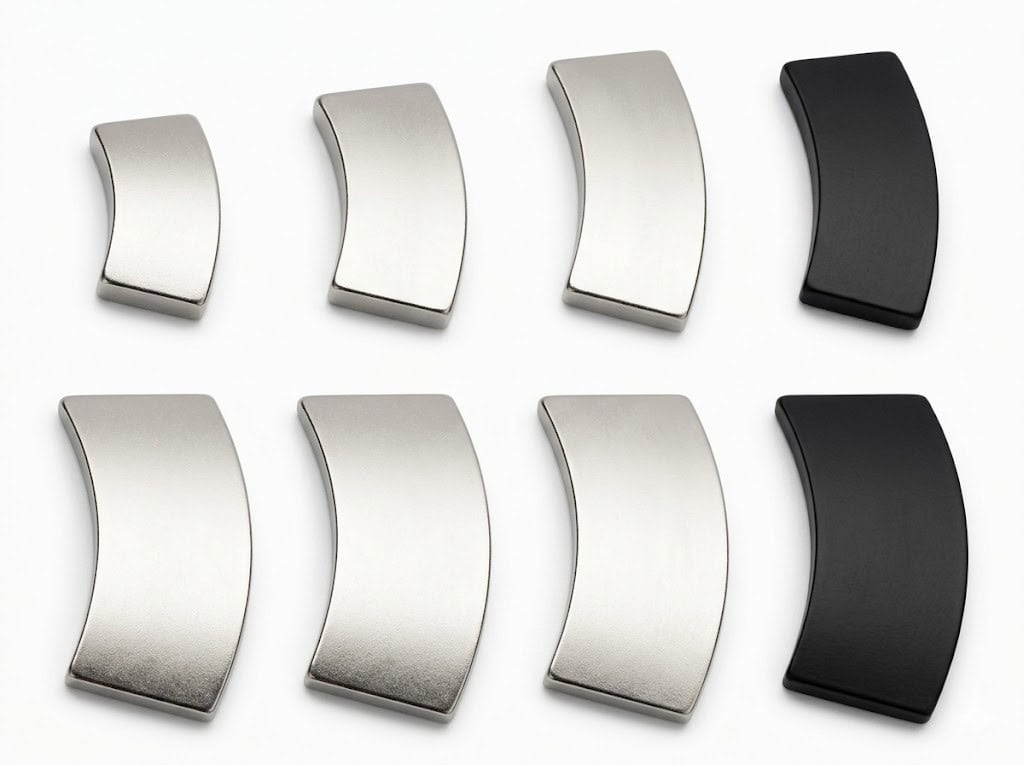
We make arc segments,[6] bread-loaf segments, segmented stacks and radially oriented rings. We magnetize axially, diametrically, radially or in multi-pole patterns. For a sector segment, send the drawing and we'll confirm what we can make.
What gets harder with axial flux magnets?
Most axial flux trouble starts at the magnet face, not the grade. Small height differences between segments show up straight in the air gap.
Matching matters in both layouts, but a disc shows it faster. We hold flux per pole within ±2% and match each set to one rotor, as we do for servo motor magnets.[7]
Eddy current loss needs attention in any layout. The stator's changing field drives current loops inside a solid magnet, and that loss turns into heat.[8] Splitting each pole into thin segments cuts those loops. We already segment poles this way: one delivery drone motor we supply uses N48H with 6 segments per pole at ±0.05 mm.
Retention is the third thing to settle early. The segments sit on a disc face and the outer edge moves fastest. Agree the bonding and any retaining ring before you freeze the magnet drawing.
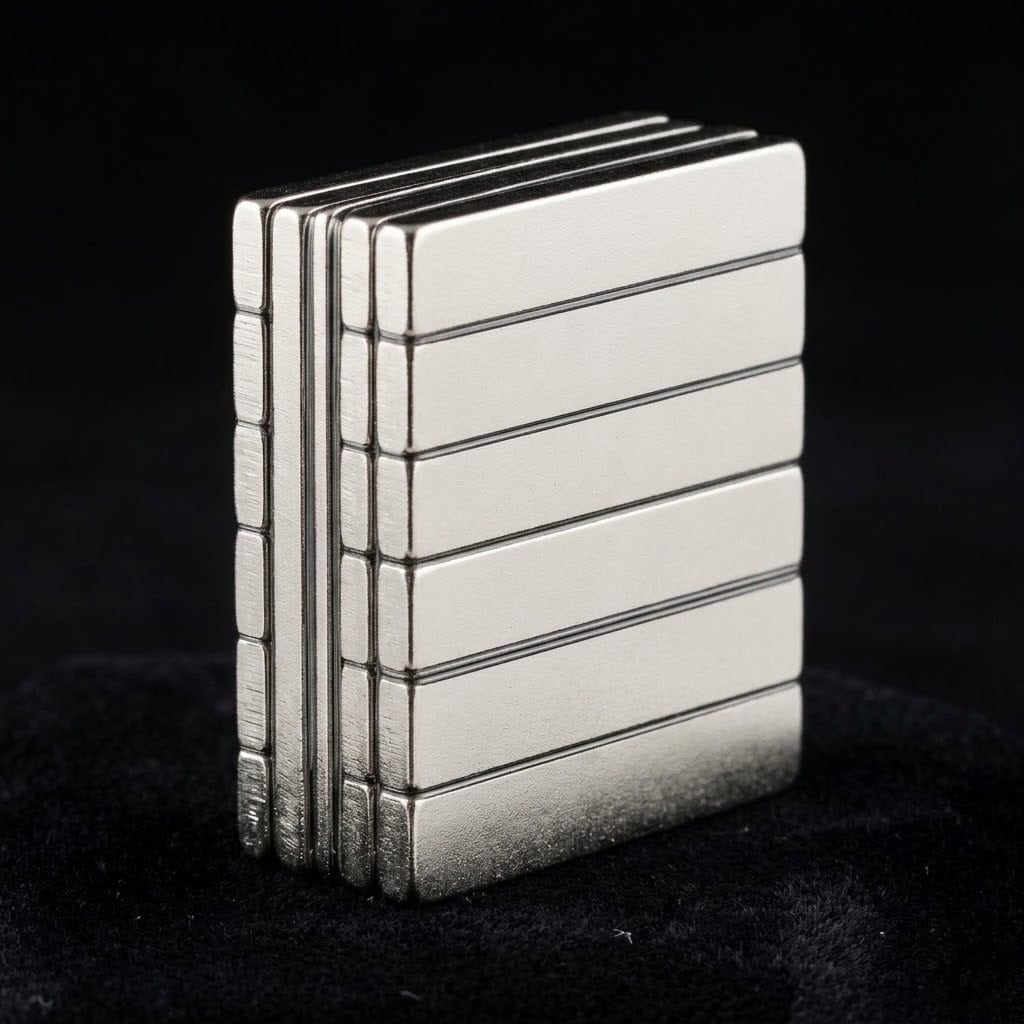
If your drawing gives a thickness tolerance but no flatness callout, add one. On a disc rotor, flatness is what the stator actually sees.
Coating thickness counts in the gap
On a disc rotor the coating sits on the face that looks at the stator, so its thickness adds to the magnetic air gap. Specify the coating and its thickness with the segment thickness tolerance. We coat in nickel, zinc, epoxy, gold or Parylene, plus custom finishes.
Which magnet grade should each motor use?
Grade follows the hottest point the magnets will see, not the motor layout, because NdFeB loses coercivity as it heats up.[9] Pick the suffix for temperature first, then the number for flux. Our grade guide explains both.[10]
| Motor type | Grades we typically supply |
|---|---|
| Drone motors | N48H, N50SH |
| Servo motors | N45SH, N45UH, N48UH, N42EH |
| EV traction motors | N42SH, N45SH |
| Humanoid robot joints | N48UH, N45UH, N52M, N45SH |
The layout doesn't change the rule. An axial flux rotor that sees the same hot-spot temperature starts from the same suffix.
What should you send a magnet supplier for an axial flux design?
- A drawing of one segment, with thickness and flatness tolerances
- Magnetization direction and the number of poles on the disc
- The highest temperature the magnets will see
- How tightly flux must match from pole to pole
- Annual quantity and the date you need samples
The tolerances set the air gap, the pole count sets how we magnetize, and the temperature sets the grade. The motor types we supply are listed on our motor magnets page.[11]
What we run
Flux per pole within ±2%, matched per rotor
Axial, diametric, radial and multi-pole magnetization
No MOQ
The decision in one line
Go axial flux for short, wide, torque-dense packages, and stay radial when you've got the length.
Axial flux: sector segments, axial magnetization, tight thickness and flatness.
Radial flux: arc or bread-loaf segments, matched per rotor, grade by temperature.
Frequently asked questions
Is an axial flux motor always better than a radial flux motor?
No. Axial flux suits short, wide packages that need high torque. Radial flux remains simpler to build for most servo, BLDC and traction motors.
Can axial flux motors use ferrite magnets?
Some low-cost designs do. Ferrite gives a much weaker field, so the motor grows for the same torque. Most compact axial flux designs use NdFeB.
Do axial flux motors need a Halbach array?
Not necessarily. A Halbach array strengthens the field on one side of the disc and can remove the back iron, but it adds magnetizing and assembly steps. Many designs use simple alternating poles.
How do single-rotor and double-rotor axial flux motors differ for the magnets?
A single-rotor motor has one magnet disc facing one stator. A double-rotor motor places the stator between two magnet discs, so you order two matched sets aligned pole to pole.
Planning an axial or radial flux rotor?
Send one segment drawing with the magnetization direction and working temperature. An engineer replies within 24 hours on working days.
Send your drawing for a quoteIn rare-earth magnets since 1992 · No MOQ · Replies within 24 hours on working days
References
- Axial flux motor, Wikipedia
- Design of axial-flux permanent-magnet low-speed machines and performance comparison between radial-flux and axial-flux machines, A. Parviainen, doctoral thesis, Lappeenranta University of Technology
- A closer look at axial flux motors, Charged EVs
- Axial flux motors, E-Mobility Engineering
- Comparison of an axial flux and a radial flux permanent magnet motor for solar race cars, R. Al Zaher et al., ICEM 2010, IEEE
- Neodymium arc magnets, Mainrich Magnets
- Neodymium magnets for servo motors, Mainrich Magnets
- Eddy current, Wikipedia
- Neodymium magnet, Wikipedia
- Neodymium magnet grades explained, Mainrich Magnets
- Motor magnets, Mainrich Magnets